
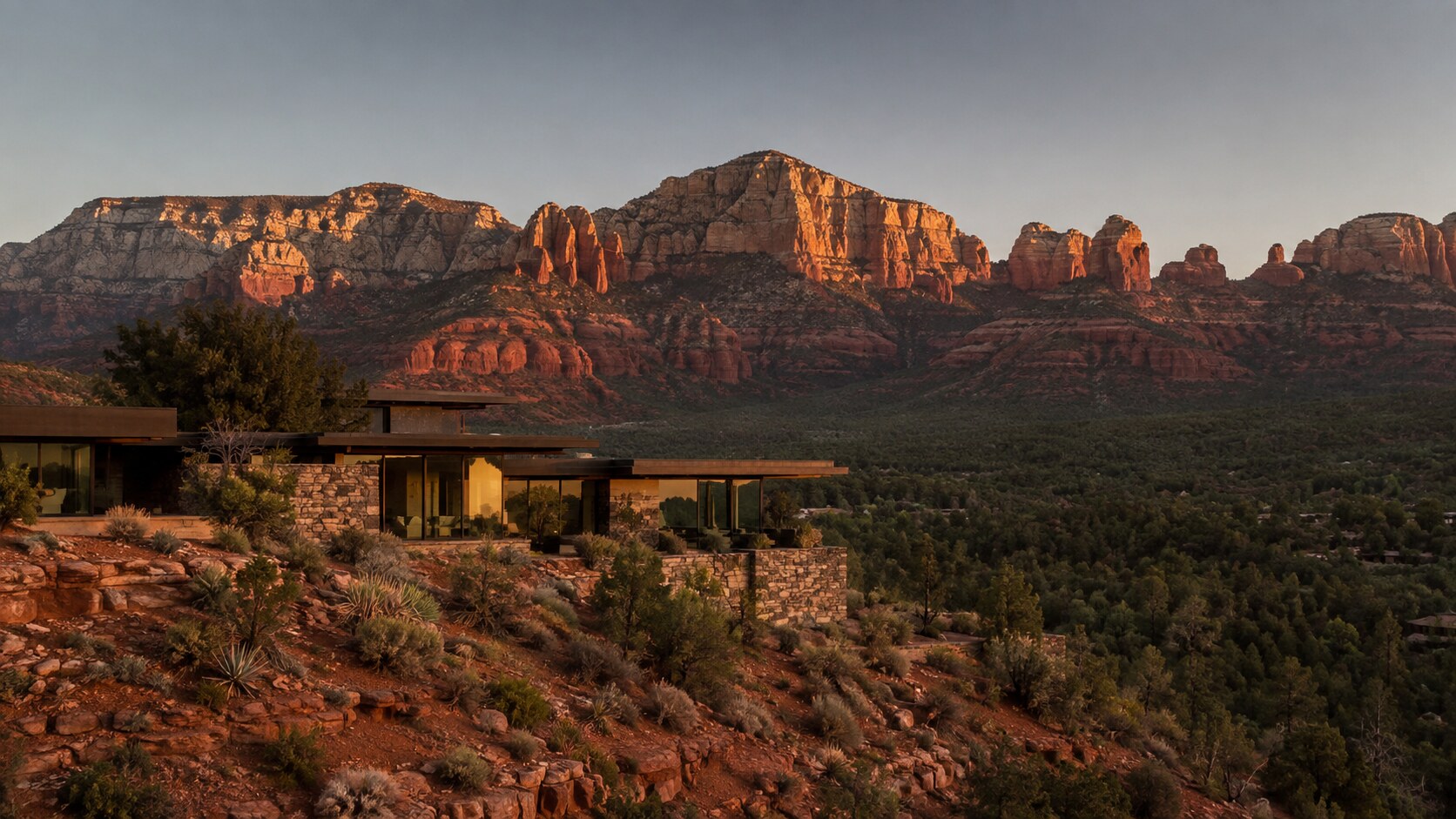
“Borders National Forest” is one of those phrases that immediately gets attention in a Sedona listing.
Buyers picture privacy, open space, red-rock views, and the ability to walk from the property into miles of trails. But does the feature actually translate into a higher sale price?
Recent Sedona MLS sales suggest that it often accompanies higher values, including for some older homes. The more accurate answer is that buyers are rarely paying for the boundary alone. They are paying for the complete setting that comes with it.
1. Forest-adjacent homes sold for more
I reviewed 125 single-family sales in Sedona ZIP code 86336 from late June through September 2025 and the comparable 2026 period.
Homes clearly marketed as bordering or backing to National Forest had:
- A median sale price of $1.943 million, compared with $1.15 million for the other sales
- A median price of $607 per square foot, compared with $505 per square foot
- A median market time of 123 days, compared with 63 days
The price difference is meaningful. It is not proof that the Forest boundary created a 20% premium by itself.
The Forest-bordering homes were generally larger, newer, and located on larger lots. Many also had panoramic views, pools, guest accommodations, creek access, or distinctive architecture. Once location and those property characteristics were considered, the data did not support assigning one reliable percentage to the boundary alone.
The stronger conclusion is that National Forest adjacency improves a property’s overall package. It does not replace good pricing, condition, or presentation.
2. Location changed the result
| Area | Forest-adjacent sales | Median price per sq. ft. | Other sales | Other median price per sq. ft. |
|---|---|---|---|---|
| Chapel and Broken Arrow | 3 | $604 | 24 | $511 |
| West Sedona and Dry Creek | 3 | $541 | 63 | $491 |
| Red Rock Loop | 3 | $601 | 3 | $427 |
| Oak Creek Canyon | 2 | $695 | 3 | $531 |
| Uptown | 1 | $917 | 18 | $499 |
The sample becomes small when divided by area, so these are market signals, not automatic appraisal adjustments. Still, the listing descriptions help explain what buyers were purchasing.
Chapel and Broken Arrow
Forest-bordering sales in Mystic Hills and Broken Arrow emphasized Twin Buttes, close-up red-rock views, walls of windows, elevated decks, pools, remodeled spaces, and immediate access to Forest trails. Their median price per square foot was about 18% higher than the other sales in the area.
West Sedona and Dry Creek
Listings in Foothills South, North Slopes, and Spirit Trail highlighted Lizard Head, broad mesas and buttes, panoramic formations, quiet ridge settings, and large parcels. Median price per square foot was approximately 10% higher than for the other area sales, although the Forest homes were also much larger.
Red Rock Loop
The Forest-adjacent properties included settings near Cross Creek Ranch, Cathedral Vista, and Red Rock State Park. Marketing highlighted views of Thunder Mountain, Oak Creek, acreage, panoramic red rocks, and direct trail access. One property allowed the owner to ride directly into Red Rock Country. Thunder Mountain was part of the view, not the property’s neighborhood. The price-per-square-foot difference was substantial, but there were only six total sales in this comparison.
Oak Creek Canyon
The two Forest-bordering sales were newer luxury homes in Junipine with creek frontage or private creek access, outdoor living, and trails toward West Fork. Comparing them with smaller, older canyon homes would overstate the value of the boundary itself.
Uptown
The Palisades sale was the only Uptown sale in this dataset clearly marketed as bordering National Forest. The renovated home paired the boundary with broad red-rock views, trail access, and views from nearly every window. At $917 per square foot, it was a notable sale, but one property cannot establish an Uptown-wide premium.
3. Older homes could still compete when the setting was exceptional
Among Forest-bordering homes built through 1999, the median sale price was approximately $1.529 million, compared with $1.018 million for the other older homes. Median price per square foot was $546, compared with $485.
That does not mean condition stopped mattering. Several of the stronger sales also offered remodeling, newer systems, pools, flexible guest space, or well-designed outdoor areas.
But buyers did not evaluate age in isolation. A 1960s, 1980s, or 1990s home remained competitive when it offered a setting that could not be reproduced through remodeling.
4. Buyers were purchasing more than a boundary
- Specific views. Twin Buttes, Thunder Mountain, Lizard Head, mesas, buttes, and panoramic formations gave buyers a clearer picture than the generic phrase “red-rock views.”
- Usable outdoor access. Forest trails, Red Rock State Park, Oak Creek, and West Fork strengthened the lifestyle story when the access was accurate and practical.
- Privacy buyers could experience. Ridge settings, acreage, creek frontage, patios, decks, and walls of glass connected the home to the landscape.
- A home that supported the setting. Renovations, pools, guest suites, outdoor living, distinctive architecture, and newer construction helped convert a special location into a stronger sale.
Does National Forest adjacency increase value?
In this sample, Sedona homes marketed as bordering National Forest sold for more, including on a price-per-square-foot basis. Some older homes also performed well because the setting offered privacy, views, acreage, or trail access that buyers could not duplicate later.
But National Forest adjacency was not a shortcut around pricing. These homes generally took longer to sell, and much of the raw price difference was connected to location and the other features that came with the property.
For sellers, market the actual experience. Identify the formations in view, explain the trail or creek access accurately, show how the outdoor areas connect to the landscape, and price the home against the correct micro-market.
For buyers, compare the entire property. The boundary may be valuable, but view orientation, privacy, lot usability, home condition, and location determine what it is worth.
Source: MLS exports reviewed October 1, 2026. Data includes single-family sales in ZIP code 86336 closing from late June through September 2025 and the comparable 2026 period. Area groupings are broad market segments, and small samples should not be interpreted as appraisals or fixed price adjustments. Village of Oak Creek sales were not included in the supplied dataset.